The Battle of
Polashi (পলাশী)
About the game and how to play
What it is
The Battle of Polashi is an online multiplayer social deduction game for 5 to 10 players, set around the Battle of Plassey (Polashi) in Bengal, 1757. Each player is secretly dealt a historical character on one of two sides. The loyal Nawabs try to win the campaign; the East India Company (EIC) conspirators hide among them and sabotage it from inside.
It runs in the browser: one player opens a room, shares the room code or invite link, and everyone joins from their own phone or computer. Nobody needs an account.
Step by step
A whole game from start to finish, as it looks on screen. The control to press is outlined in gold.
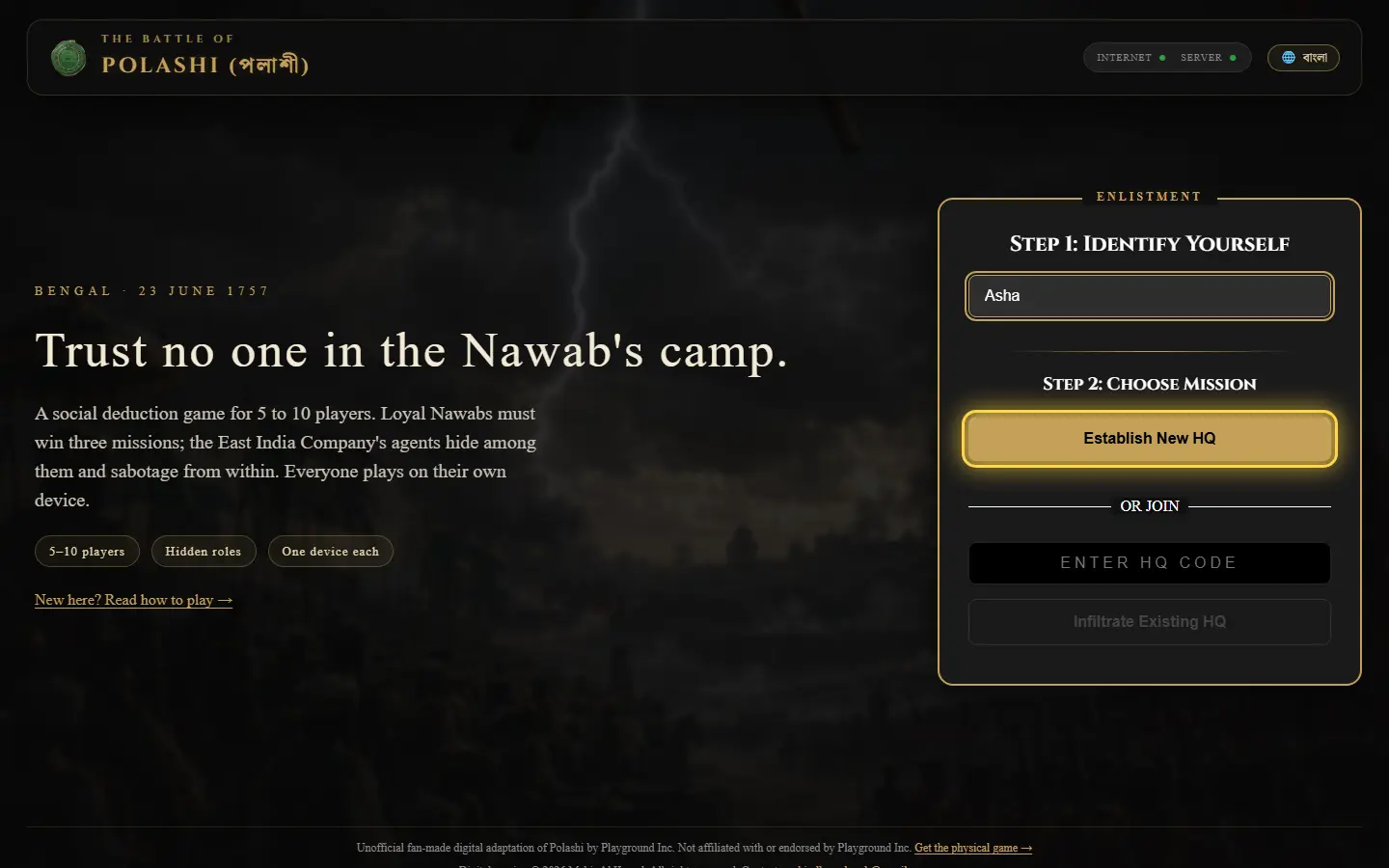
Step 1. Create a room
Host
Type an alias under Step 1, then press Establish New HQ. Whoever creates the room is the host and runs the game.
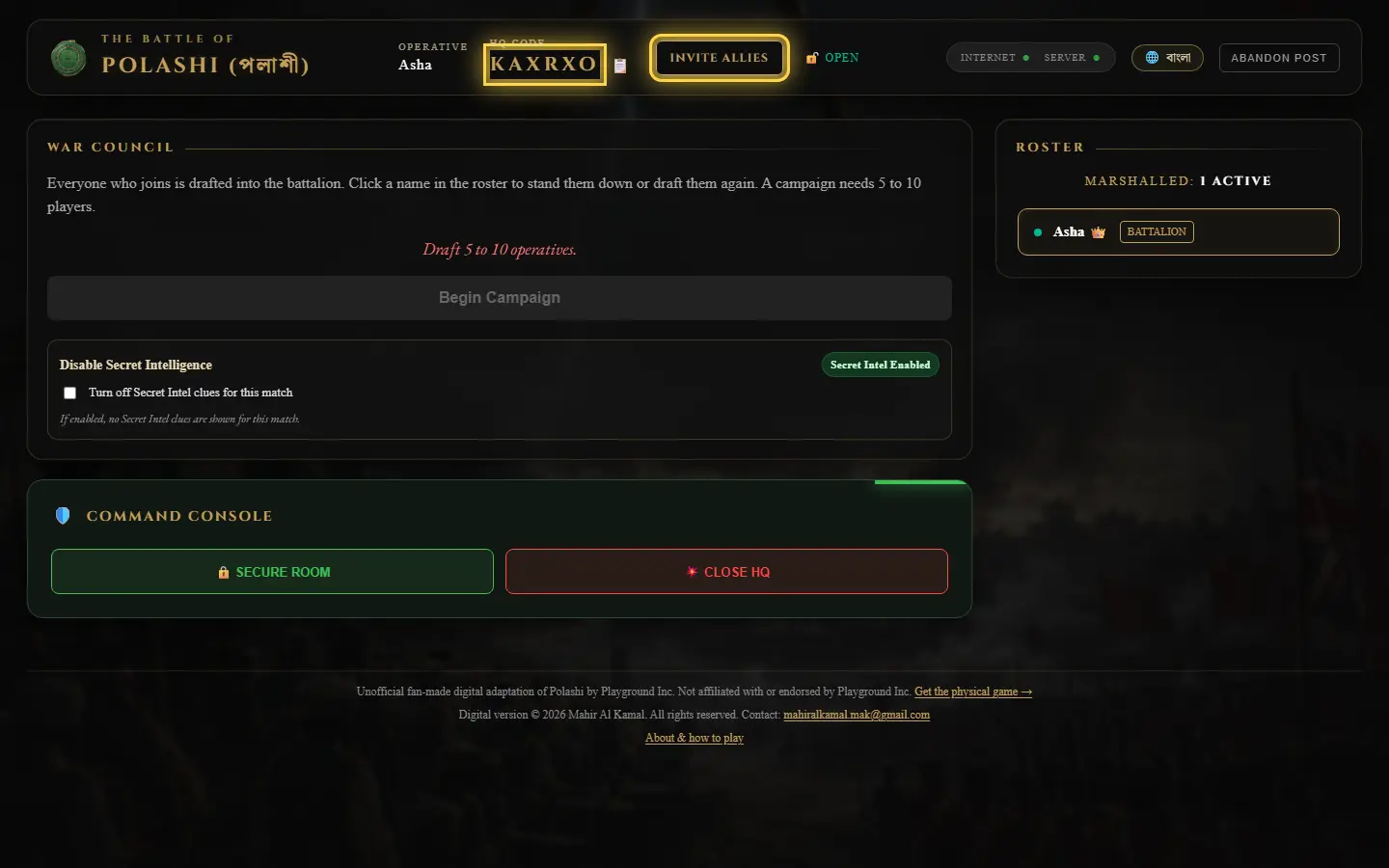
Step 2. Share the room code
Host
The six-character room code appears next to your name (on a phone, tap your name bar to show it). Read it out, or press Invite Allies to copy a link that fills the code in for your friends.
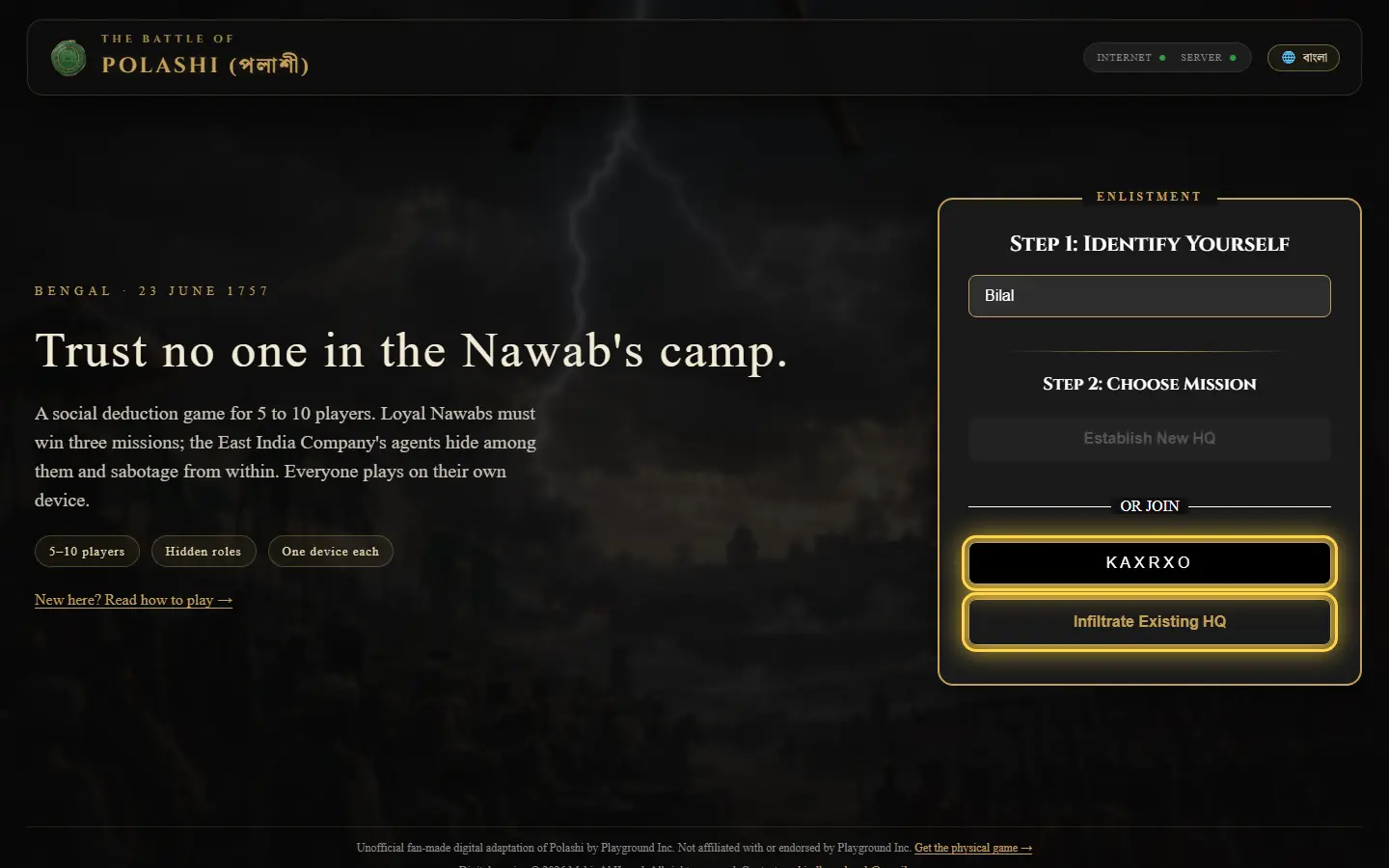
Step 3. Join the room
Everyone else
Type an alias, enter the room code under Or join, and press Infiltrate Existing HQ.
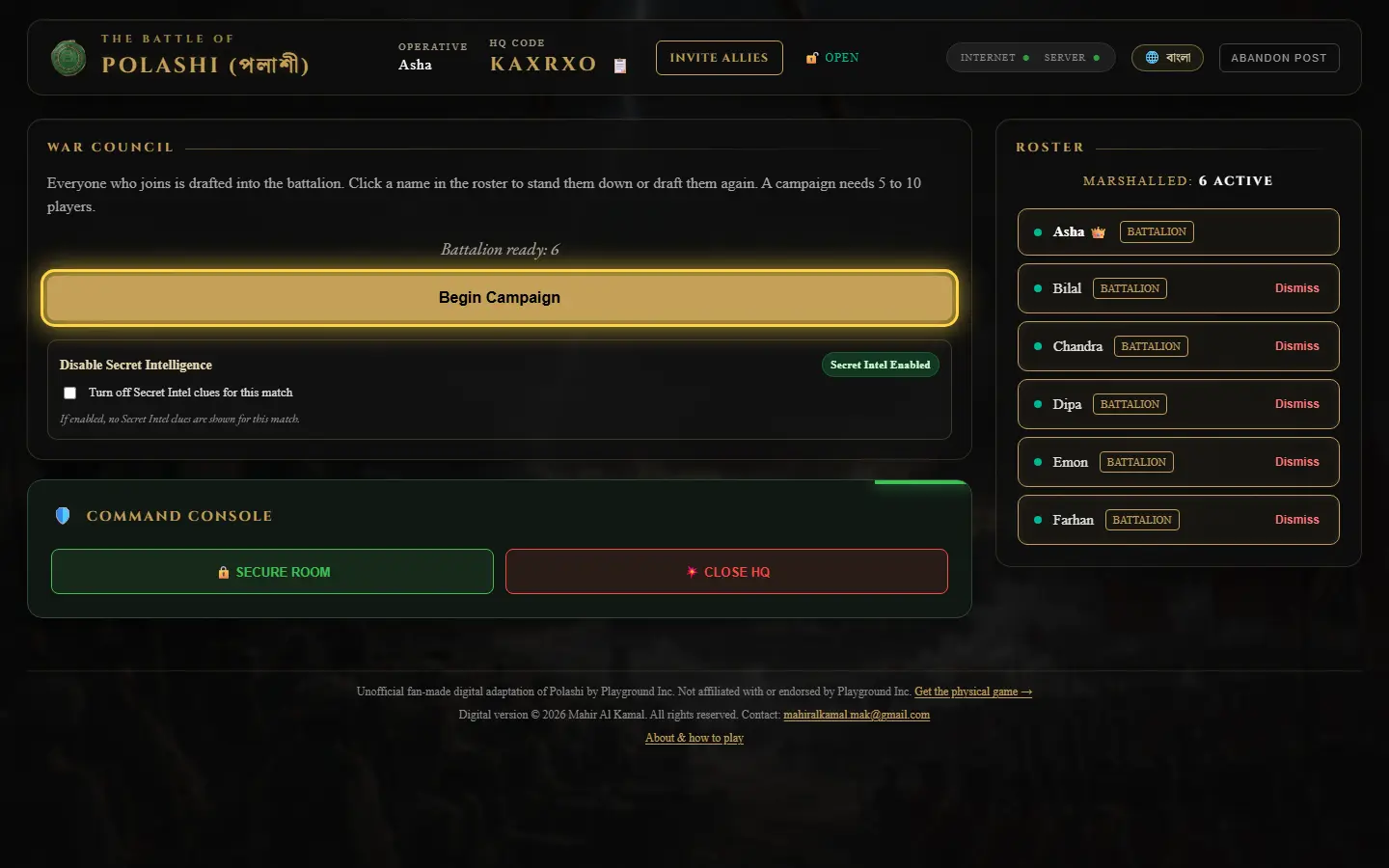
Step 4. Gather the battalion
Host
Everyone who joins is drafted into the battalion; tap a name in the roster to stand them down as an observer. With 5 to 10 players drafted, press Begin Campaign. Before that you can switch off Secret Intel, or press Secure Room so nobody else can join.
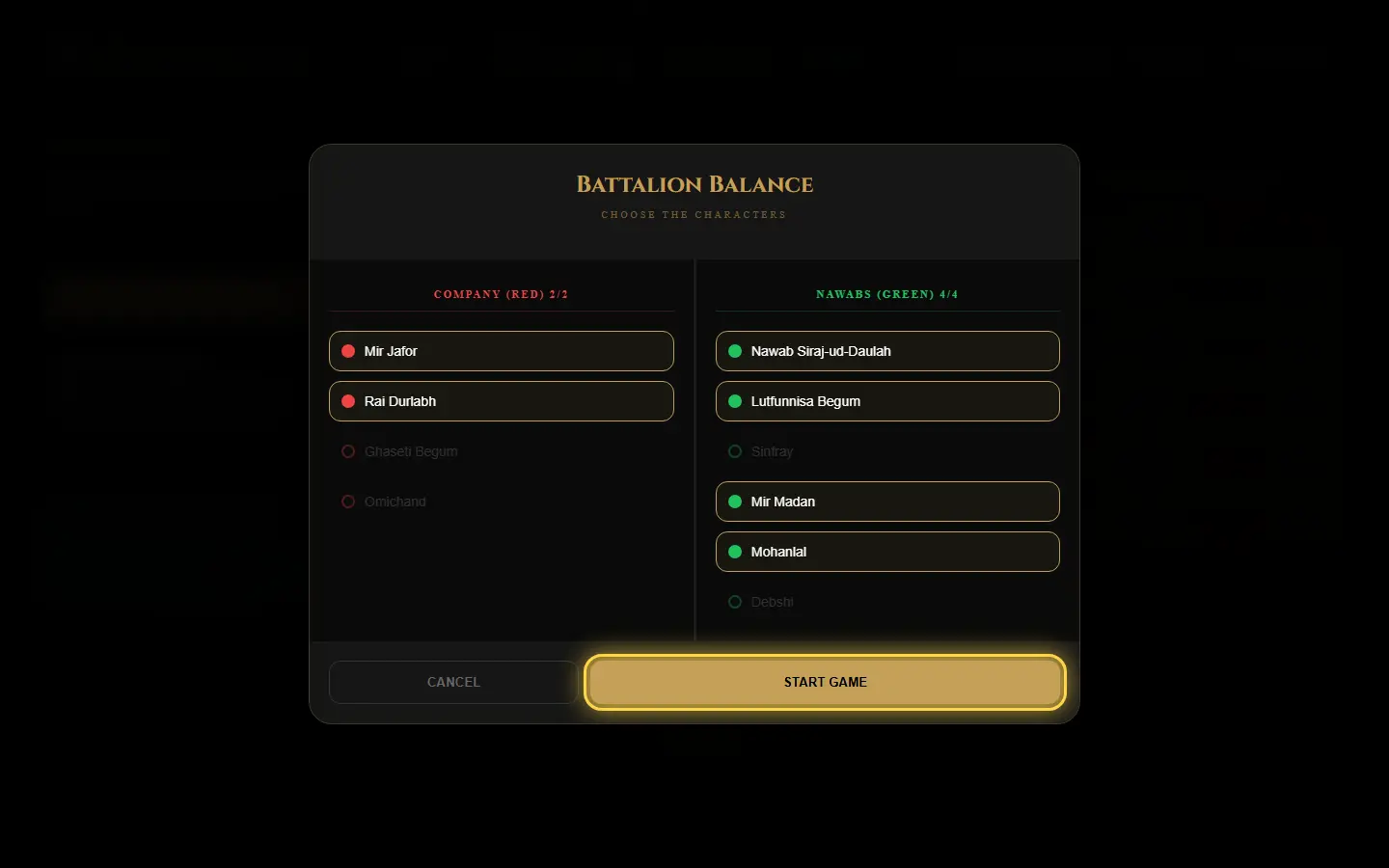
Step 5. Choose the characters
Host
Mir Jafor and Mir Madan are always in. Pick characters for each side until the counts at the top of both columns are full, then press Start Game. Each player is dealt one at random.
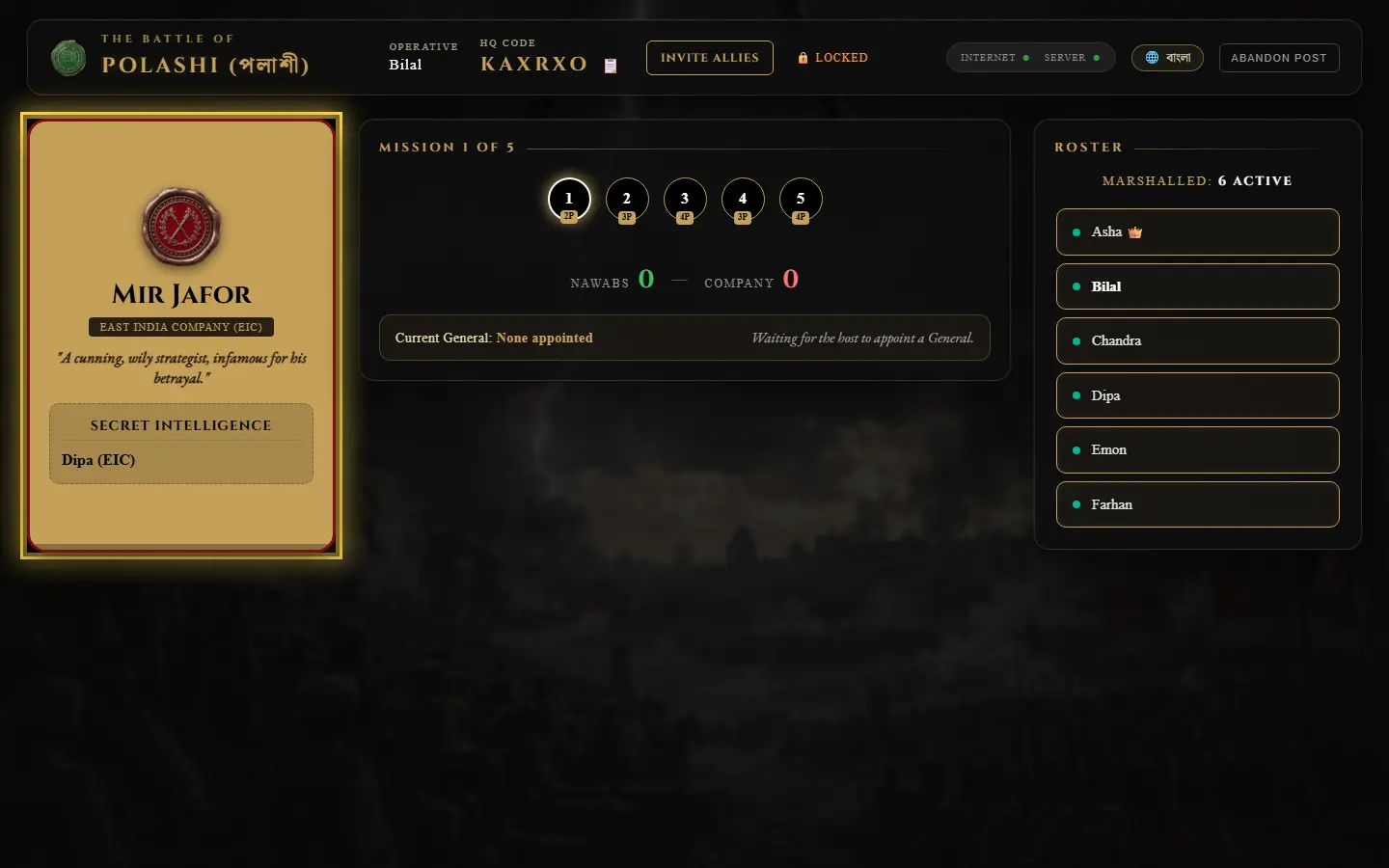
Step 6. Read your secret card
Everyone
Tap the Classified card to see your character and side; tap again to hide it. Some characters also get Secret Intelligence about other players. Keep your screen to yourself.
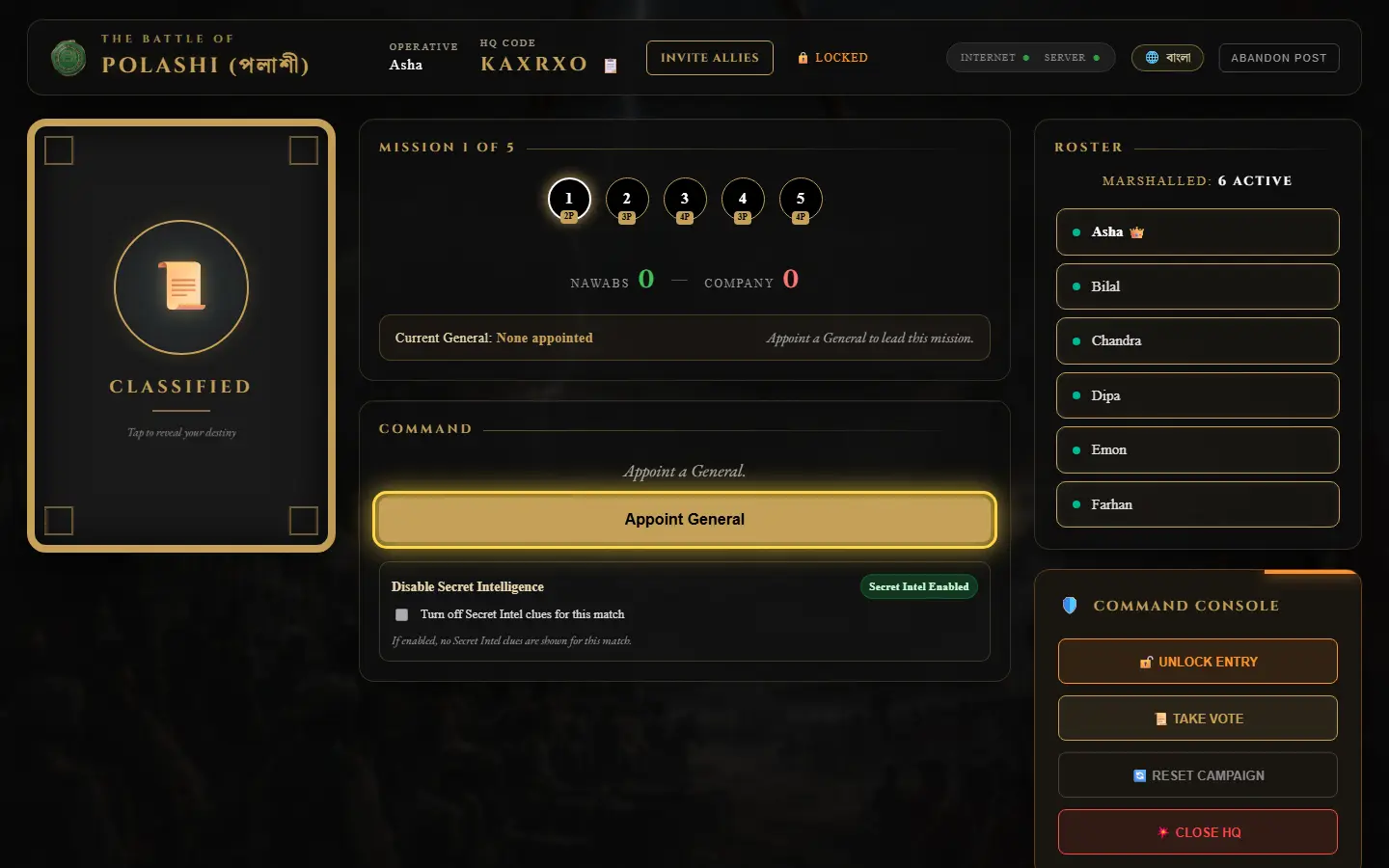
Step 7. Appoint a General
Host
Press Appoint General. The game picks a player and announces them to everyone. The host does this at the start of every round, and again after a rejected battalion.
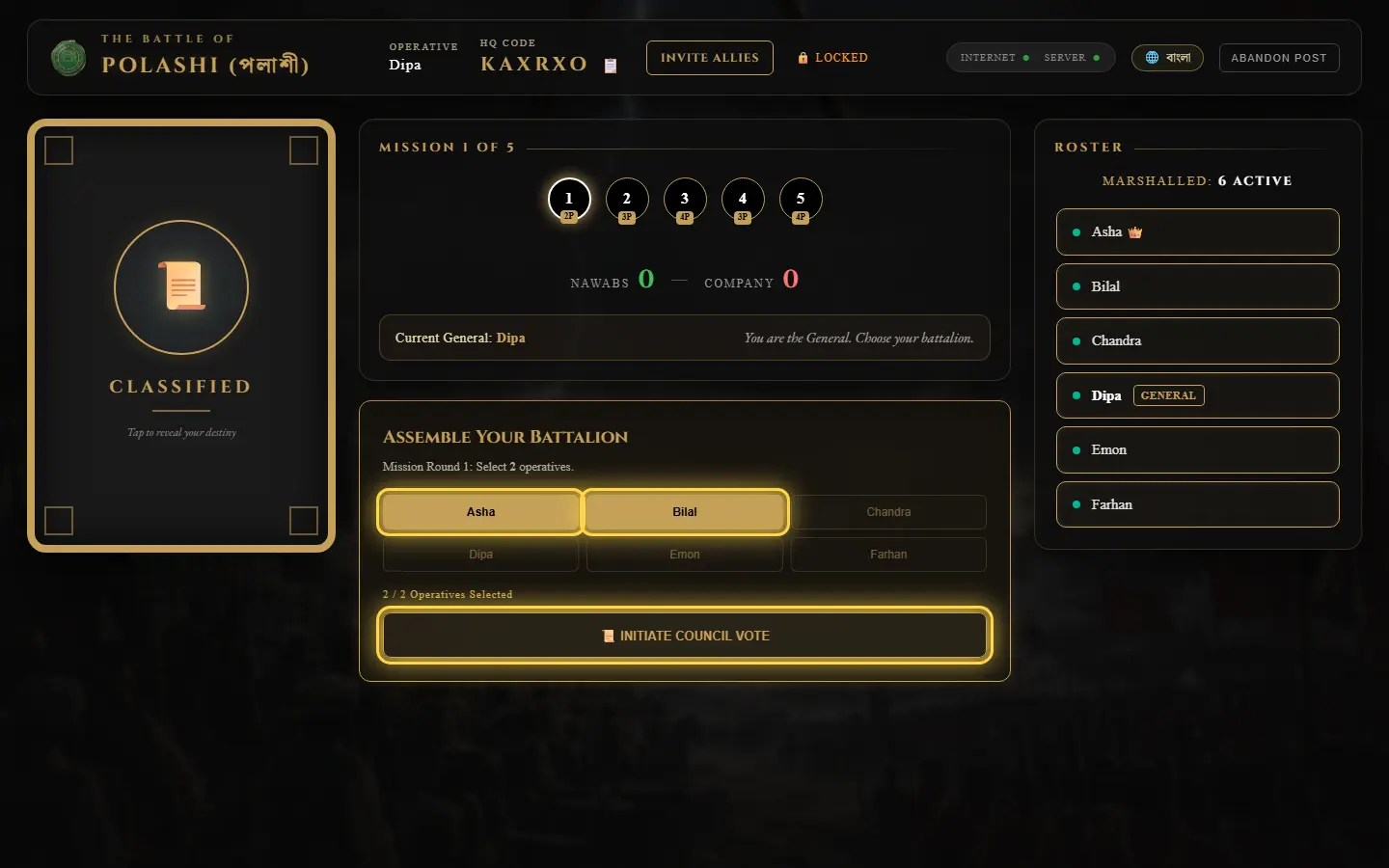
Step 8. Pick the battalion
The General
Tap names until the battalion is the size shown for this round, then press Initiate Council Vote.
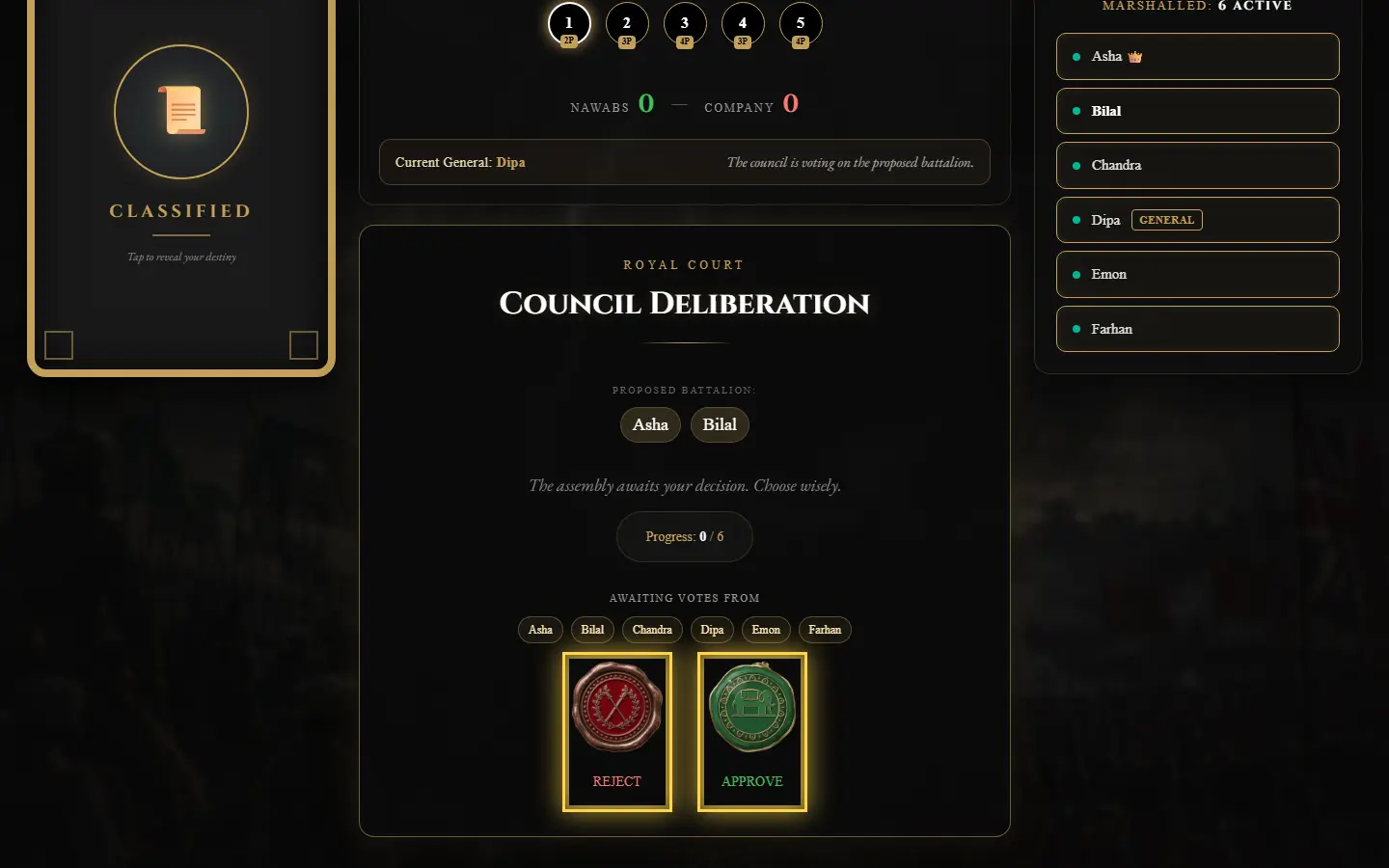
Step 9. Approve or reject
Everyone
Tap the green seal to Approve the battalion or the red seal to Reject it. Choices stay hidden until everyone has voted. If half or more reject it, the battalion is not sent.
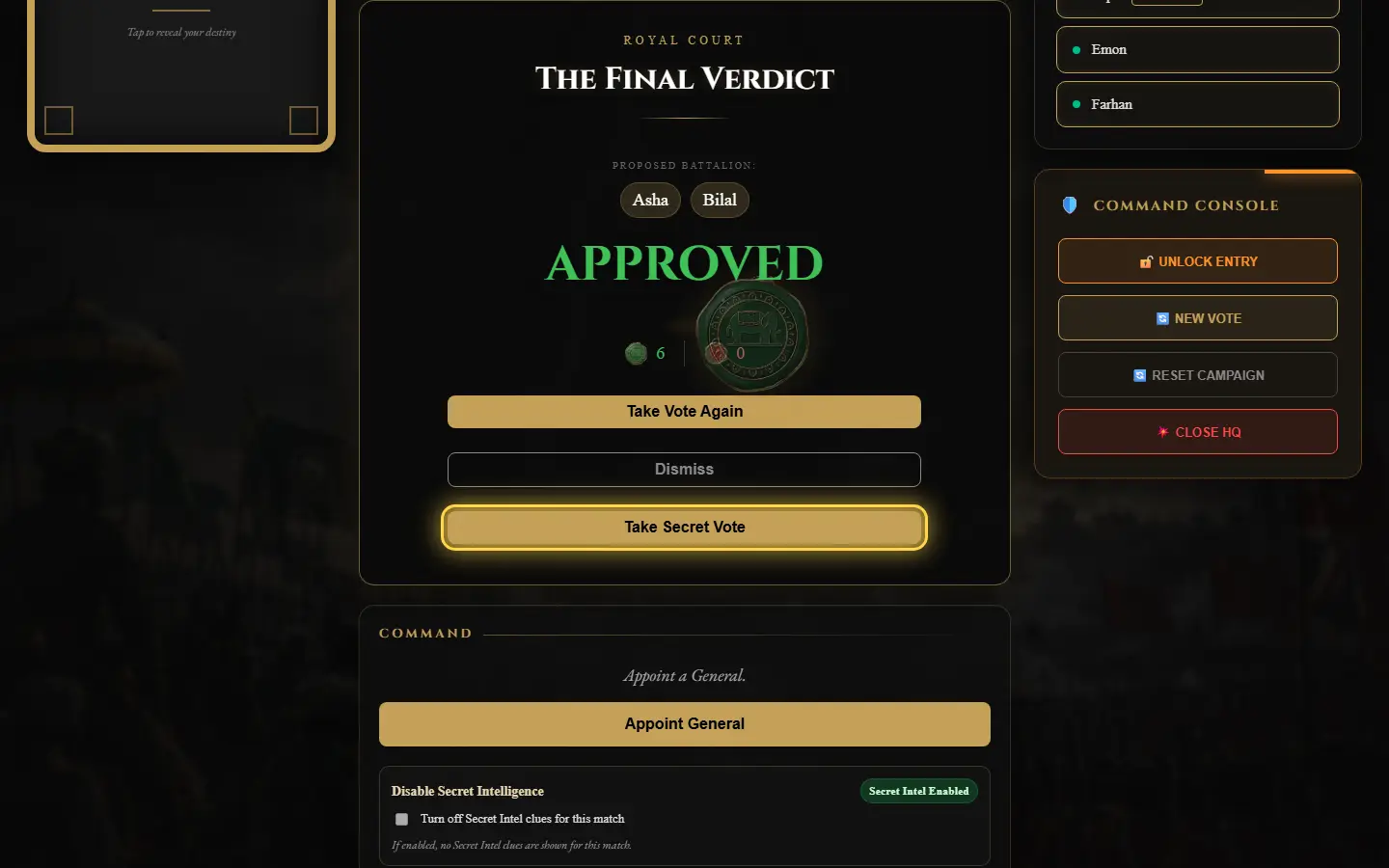
Step 10. Send the battalion
Host
The verdict shows how everyone voted. If the battalion is approved, press Take Secret Vote. If it was rejected, press Dismiss and appoint a new General.
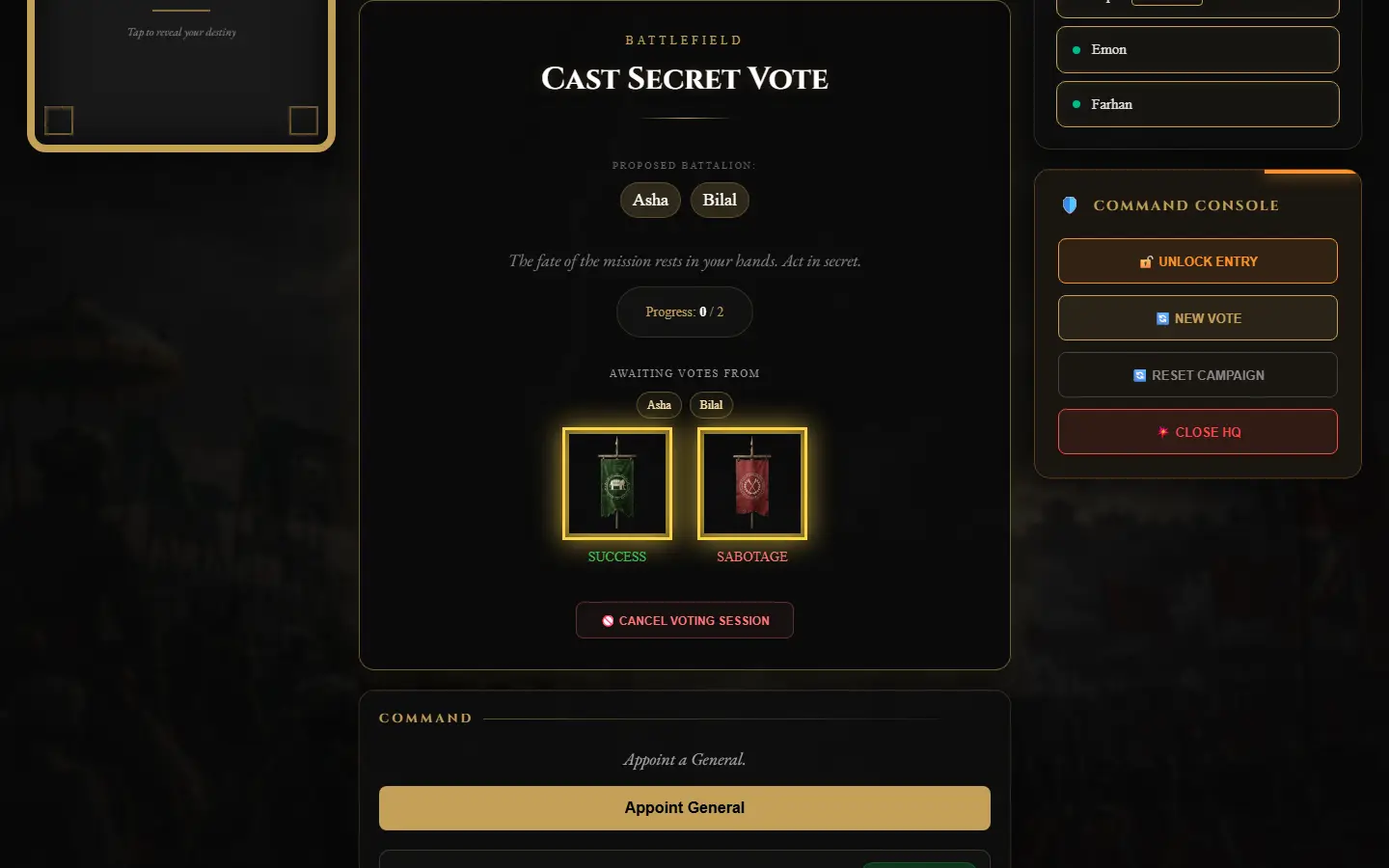
Step 11. Vote on the mission
Players in the battalion
Only the battalion votes, in secret: choose Success or Sabotage. Nawabs can only succeed, so a Nawab’s sabotage counts as a success.
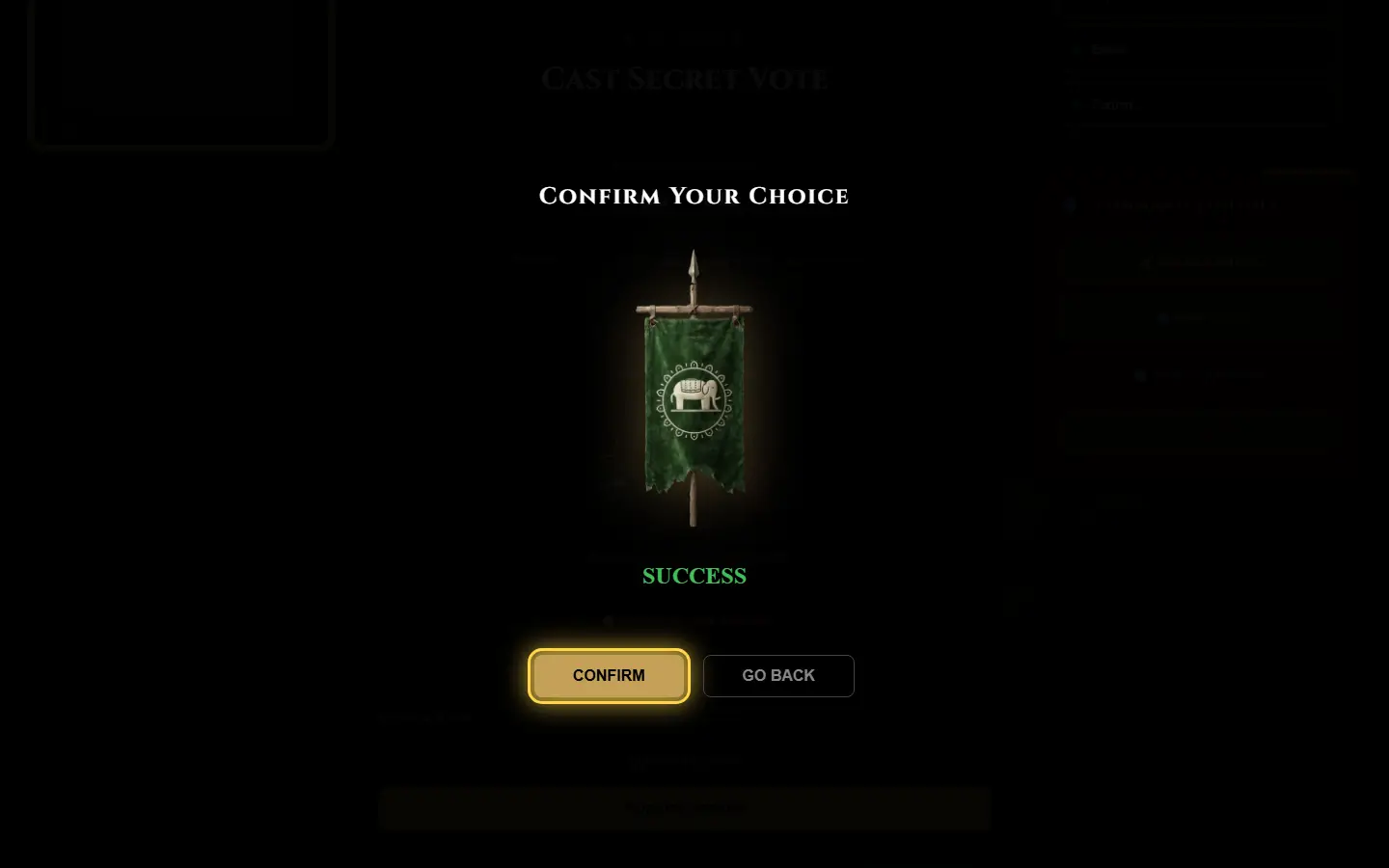
Step 12. Confirm your vote
Players in the battalion
Press Confirm to lock in your choice, or Go Back to change it.
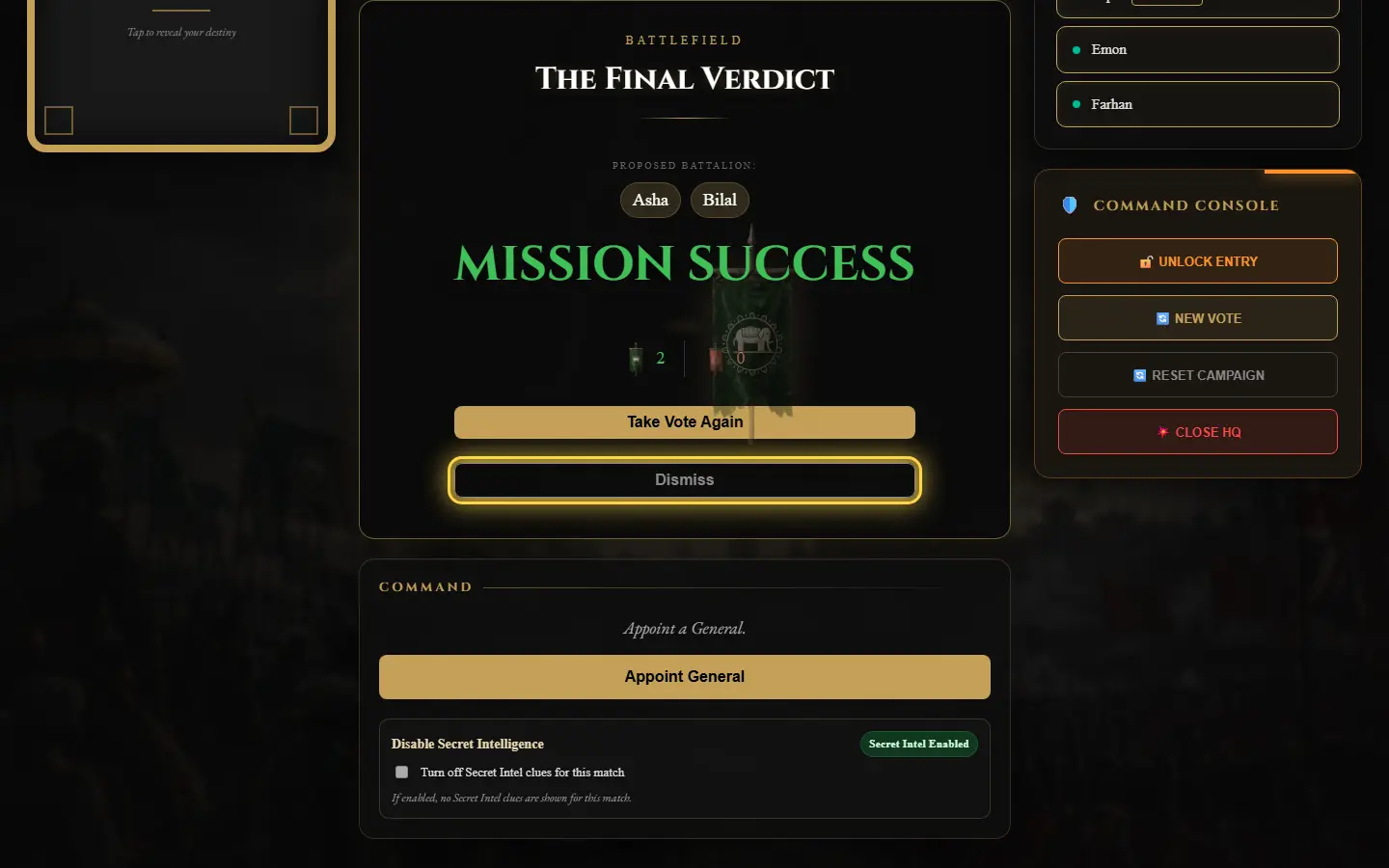
Step 13. See the result
Everyone; the host moves on
The result shows how many chose success and how many sabotage, never who. One sabotage loses the round (two in round 4 with 7 or more players). The host presses Dismiss to continue.
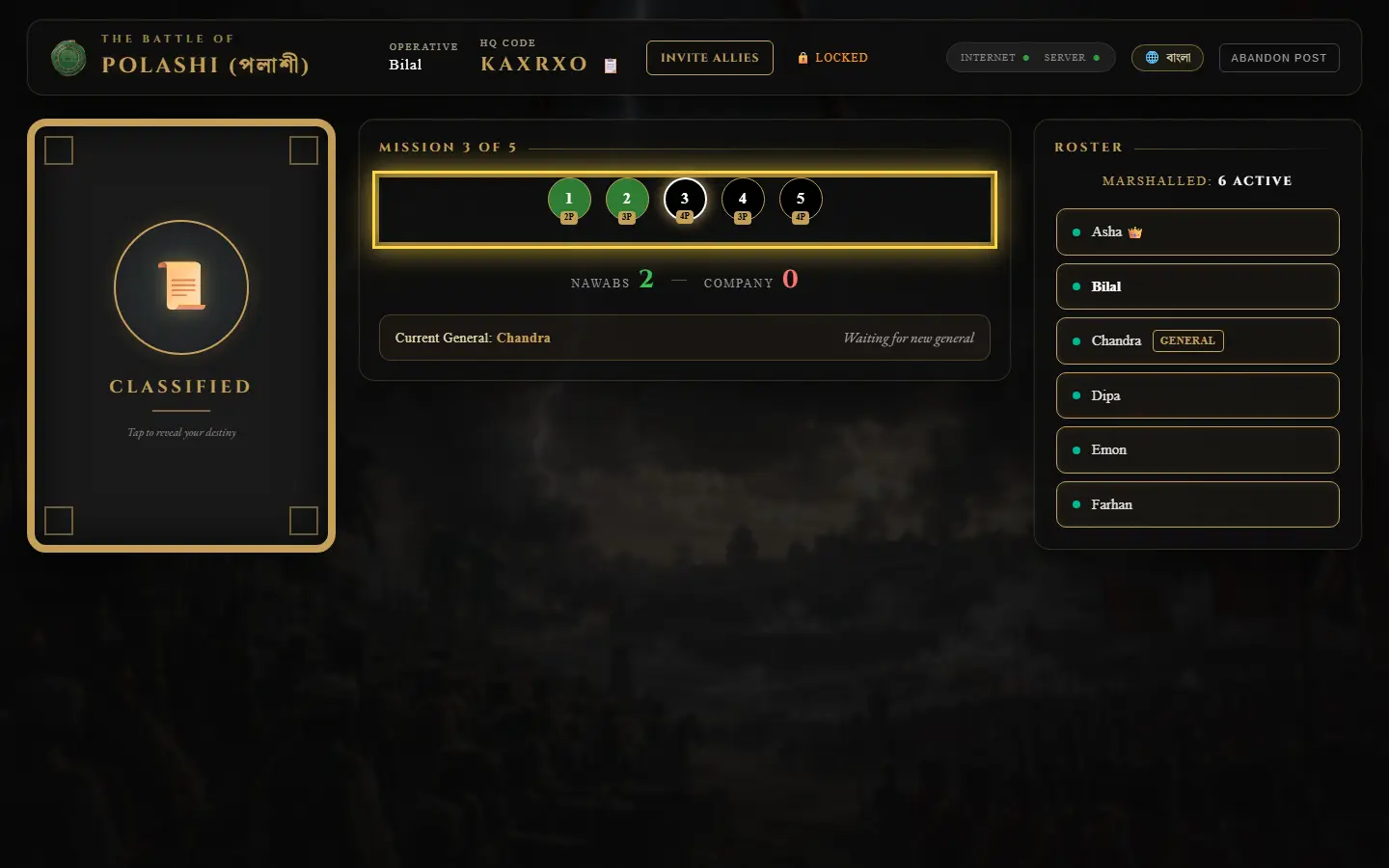
Step 14. Follow the campaign
Everyone
The five circles track the rounds: green for a success, red for a failure, and a white ring for the round being played. The label under each circle is its battalion size.
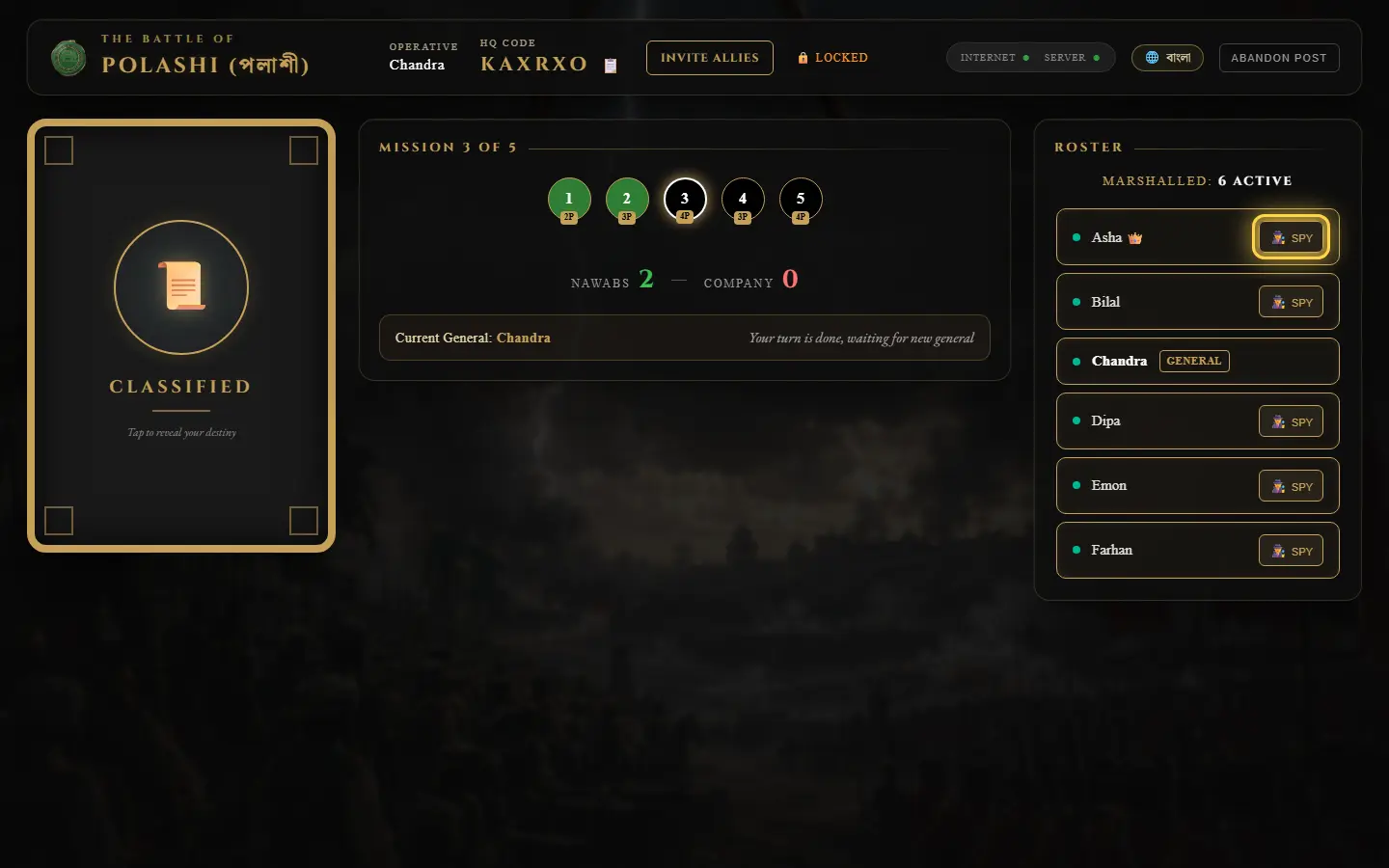
Step 15. Use the Guptochor
The Guptochor
From round 3, the Guptochor may investigate one player: press Spy next to their name in the roster (on a phone, open the Marshalled list first). Only you see their side; everyone is told an investigation happened.
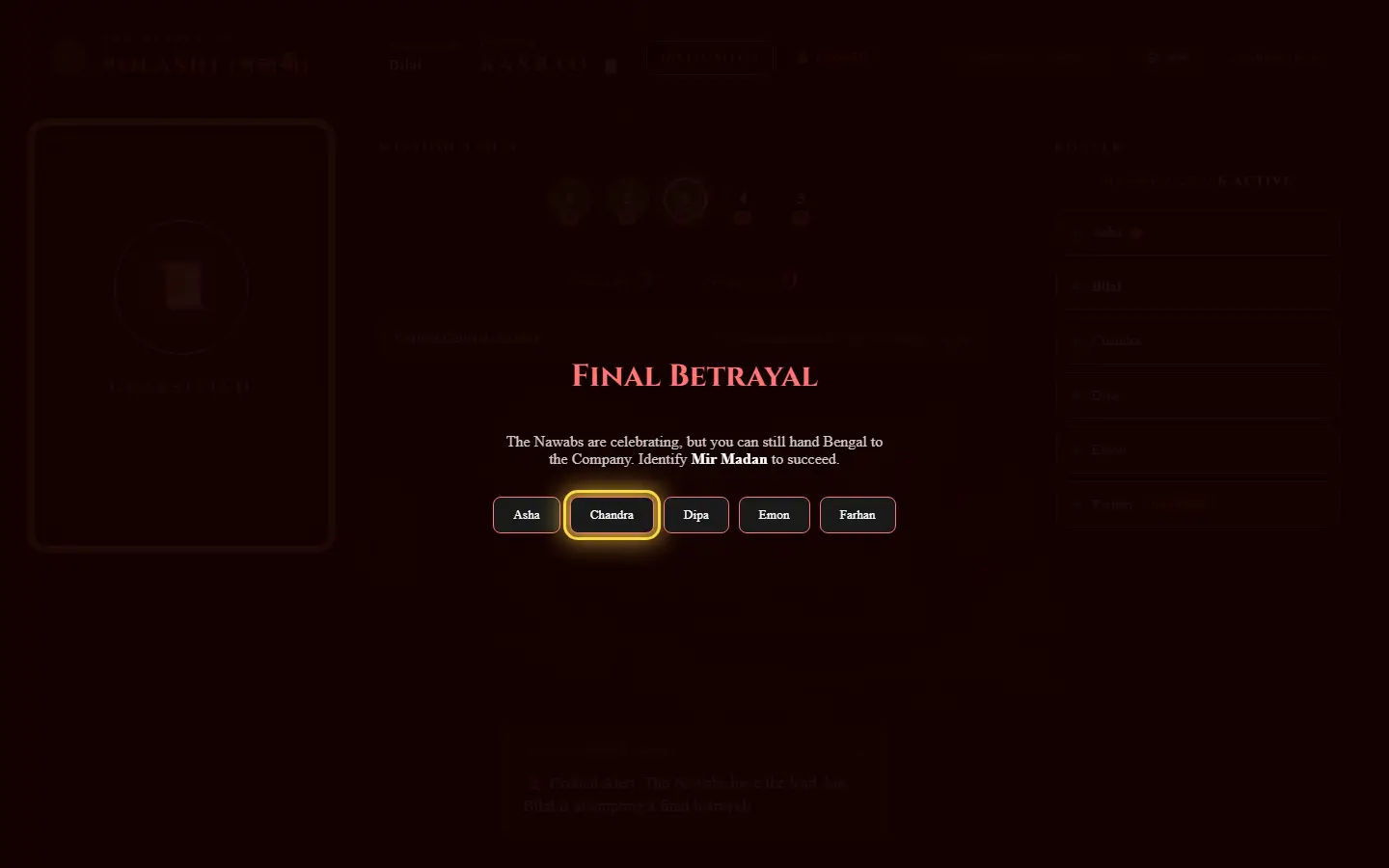
Step 16. Mir Jafor’s final strike
Mir Jafor
If the Nawabs win three rounds, Mir Jafor names the player he thinks is Mir Madan. A right guess hands Bengal to the Company; a wrong one and the Nawabs win.
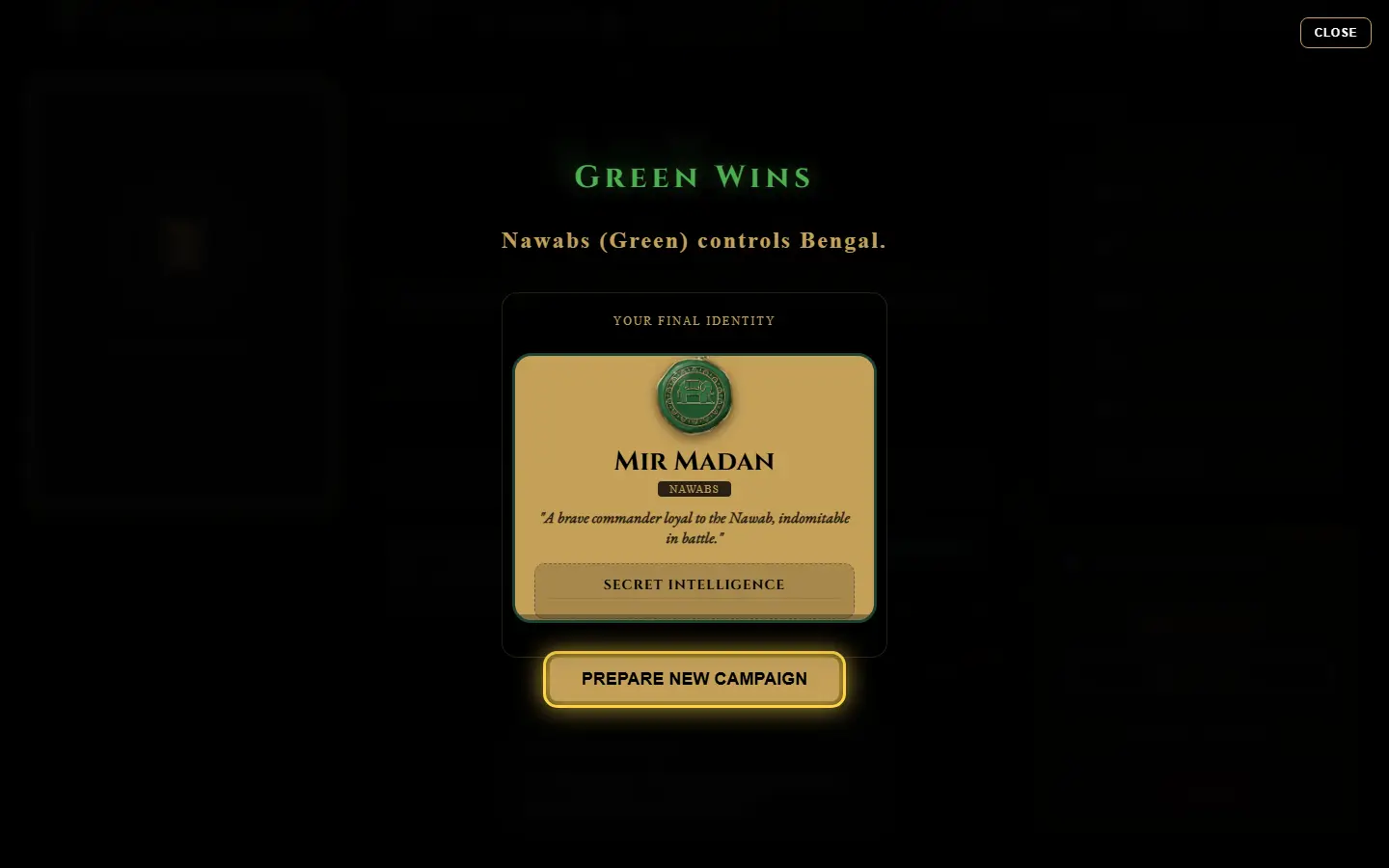
Step 17. Game over
Everyone; the host decides what next
The winner is announced and every card is revealed. The host presses Prepare New Campaign to return to the lobby with the same players, or Close HQ to end the room.


The two sides
- Nawabs — Nawab Siraj-ud-Daulah, Lutfunnisa Begum, Mir Madan, Mohanlal and their allies. They are the majority, but they do not know who is on their side.
- East India Company — Mir Jafor, Rai Durlabh, Ghaseti Begum, Omichand. Fewer in number, and they win by staying hidden.
| Players | 5 | 6 | 7 | 8 | 9 | 10 |
|---|---|---|---|---|---|---|
| Nawabs | 3 | 4 | 4 | 5 | 6 | 6 |
| EIC | 2 | 2 | 3 | 3 | 3 | 4 |
Your character card is shown only on your own screen. Depending on the room settings, some characters also receive secret intelligence about who else is who.
The characters and their powers
Before the game the host picks which characters are in play; Mir Jafor and Mir Madan are always in. What a character knows appears under Secret Intelligence on their card, unless the host has switched Secret Intel off.
- Mir Jafor (Company) — sees who the other Company members are, and which of them is Omichand. If the Nawabs win three rounds, he gets one guess at who Mir Madan is: a right guess wins the game for the Company.
- Rai Durlabh (Company) — sees the other Company members, and which of them is Omichand. Mir Madan cannot see him.
- Ghaseti Begum (Company) — sees the other Company members, and which of them is Omichand. Mohanlal sees her name next to Mir Madan's, without knowing which is which.
- Omichand (Company) — works alone: he is not told who the other Company members are, although they know him. His intel shows two decoy names.
- Mir Madan (Nawabs) — sees every Company member except Rai Durlabh. He has to guide the Nawabs without giving himself away, because Mir Jafor's last strike is aimed at him.
- Mohanlal (Nawabs) — sees two names, Mir Madan and Ghaseti Begum (if she is in play), but not which is which.
- Nawab Siraj-ud-Daulah, Lutfunnisa Begum, Sinfray and Debshi (Nawabs) — no special knowledge. Their intel shows two historical names that are not in the game, as decoys.
How a round works
The campaign is played over up to five rounds.
- A General is appointed. The General picks the battalion for this round. The size of the battalion is fixed by the round and the number of players.
- The council votes. Every player votes openly to approve or reject the proposed battalion. If half or more reject it, the battalion is not sent and a new proposal is needed.
- The battalion votes in secret. Each member chooses success or sabotage. Nawabs can only choose success; EIC members may sabotage. Only the count is revealed, never who voted what.
- The round is scored. One sabotage is enough to lose the round, except in round 4 with 7 or more players, where it takes two.
| Players | Round 1 | Round 2 | Round 3 | Round 4 | Round 5 |
|---|---|---|---|---|---|
| 5 | 2 | 3 | 2 | 3 | 3 |
| 6 | 2 | 3 | 4 | 3 | 4 |
| 7 | 2 | 3 | 3 | 4* | 4 |
| 8 | 3 | 4 | 4 | 5* | 5 |
| 9 | 3 | 4 | 4 | 5* | 5 |
| 10 | 3 | 4 | 4 | 5* | 5 |
* two sabotages needed to lose this round
From round 3 onward there is also a Guptochor (spy). The General of round 2 holds it first and may secretly learn which side one other player is on. The player they investigate holds the Guptochor in the following round. Everyone is told that an investigation happened, but only the investigator sees the answer.
Winning, and the Mir Jafor endgame
The East India Company wins as soon as three rounds are lost. If the Nawabs win three rounds first, the game is not over yet: Mir Jafor gets one last act of betrayal. He names the player he believes is Mir Madan, the Nawab's loyal commander. If he is right, the East India Company wins anyway. If he is wrong, the Nawabs win.
So the Nawab players who know the most have to steer the votes without making it obvious who they are.
Credits
This is an unofficial, fan-made digital adaptation of Polashi, a social deduction board game published by Playground Inc. (Bangladesh). It is not affiliated with or endorsed by Playground Inc., and it uses none of their artwork, logos or rulebook text. The core mechanics come from The Resistance: Avalon by Don Eskridge.
Privacy
There are no accounts and no sign-in, and the game sets no cookies. You play under an alias of your choice, so you don't need to use your real name.
Your browser keeps the room code, your player id and a rejoin key so a reload puts you back in your seat. Leaving the room, being removed or the room closing deletes them. It also keeps a random device key, which stays after you leave so your games on this device can be grouped. It isn't linked to your name or any account. It also remembers the language you picked.
While a game runs, the server holds the room in memory and deletes it once everyone has gone. When a game starts it saves a record for statistics: the room code, each player's alias, device key, role and side, every proposed team with each player's vote on it, each mission's votes and result, Guptochor checks, dropped connections, and how the game ended. Records are kept with no set end date.
Page views are counted with Vercel Web Analytics, which is anonymous and uses no cookies.
Questions, or want your records removed? Email mahiralkamal.mak@gmail.com.